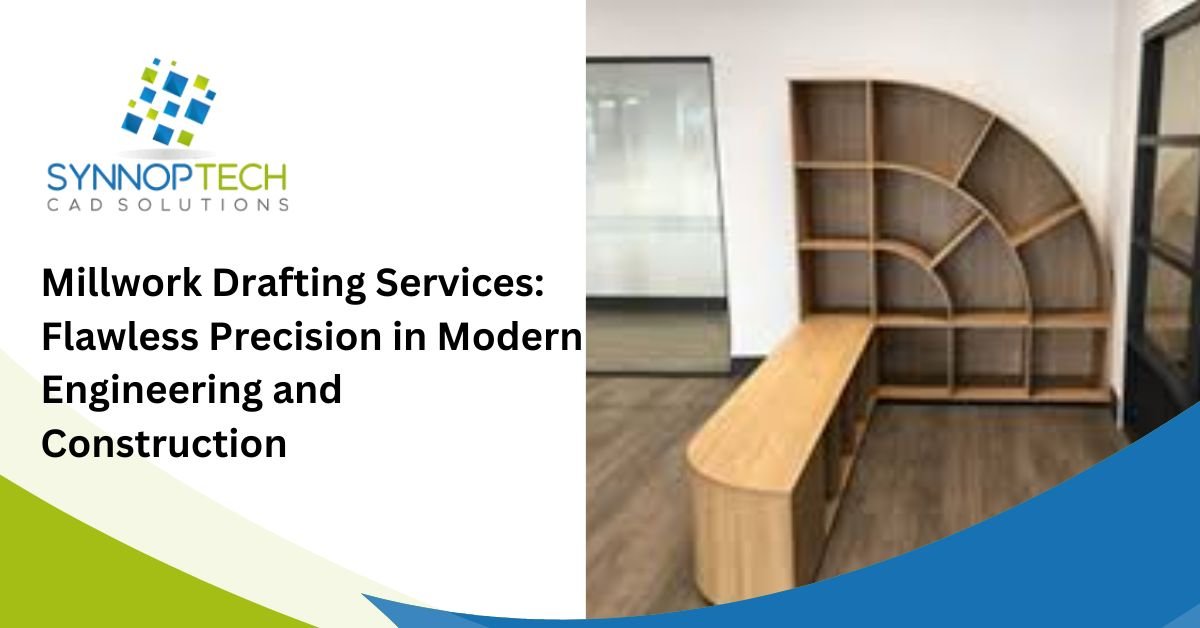
In today’s engineering and construction, precision is more than important—it is essential. As projects are continually growing in size and complexity, detail will determine whether a design will be able to be constructed as designed. Among many technical processes that can support this goal, millwork drafting services are one of the most critical. Millwork drafting services deal with ensuring that custom woodwork, cabinetry, and other manufactured elements seamlessly integrate and connect into the construction of the project.
Simultaneously, technology has made significant advancements in AI driven tools and digital technologies that are rapidly changing how millwork drafting is undertaken with better accuracy and efficiency across all sectors.
Understanding Millwork Drafting
Millwork makes reference to custom woodwork created in a mill or workshop—think more specifically about doors, draws, cabinets, mouldings, furniture arrangements, or decorative fittings. Millwork drafting is technical drawings that are with detail for these elements; in the millwork drafting is detailed dimensions, materials, finishes, and assembly of how everything goes together.
These drawings provide the means of communication between architects, engineers, contractors, and manufacturers. Simply, without millwork drafting, it would be virtually impossible to ensure that each manufactured component fits accurately within a project’s parameters or within the safety and design standards.
Why Millwork Drafting Matters
Millwork drafting is far more than a technical exercise. Its importance lies in several key areas:
- Accuracy & Precision – Guarantees stable structures and accurately fitting cabinets, stairs, and other components.
- Aesthetic Value – Supports customizability in designs that combine form and function.
- Efficient Use of Resources – Reduces waste and costs with precise measurements.
- Streamlined Production – Supplies clear guides to speed up production and installation while minimizing errors.
The Role of Technology and AI
Technology is also revolutionizing the way we draft millwork.
- Error Detection – Machine learning can quickly detect conflicts, limiting expensive mistakes.
- BIM Integration – Millwork drafts get embedded in project models while improving collaboration.
- 3D Visualisation – VR enables project stakeholders to explore the designs prior to production.
- Generative Design – Algorithms create many design options for innovative results.
- Speed & Efficiency – AI software processes data rapidly, reducing turnaround times without sacrificing quality.
Millwork Shop Drawings
At the core of millwork drafting is the shop drawing. Shop drawings are detailed documents that describe measurements, methods of construction, materials, and instructions for assembly. In essence, shop drawings convert a design concept to documents that can be used to fabricate pieces while still ensuring it meets the structural and design intent.
They typically include:
- Accurate dimensions and tolerances
- Material specifications
- Joinery and construction methods
- Assembly and installation instructions
- Final finishing details
By linking design and production, shop drawings reduce ambiguity and provide a reliable guide for manufacturers.
Why should millwork drawing services be outsourced?
Although many companies currently keep drafting in-house, there is an increasing trend to outsource drafting for several reasons.
- Cost Savings: Outside drafting provides savings by eliminating the cost of a full-time employee, benefits, and also the cost of specialized drafting technology or equipment.
- Expertise: Outsourcing will provide access to drafters who are experts in the use of, and conversant with, the latest drafting software and best-practice industry standards.
- Scalability: You can determine how much drafter support is required, and you can ramp resources up or down as the project requires.
- Focus of Employee: Given that drafting is now outsourced, your firm can fully devote management time to project coordinating, design, or construction oversight.
This approach to modern drafting is particularly useful for companies that have variable workloads or firms that have no drafting team in-house.
The future of millwork drafting is at a crossroads of skilled craftsmanship and digital capabilities. Retaining the necessary traditional skill sets for measuring and detailing is still vital; however, AI and digital technologies expand possibilities for millwork drafts. Millwork drafts are evolving in new ways that more sustainably utilize materials, preview designs in virtual spaces, improve collaborative performance in the construction process, and are all working toward developing more eco-friendly and efficient means of construction.
Millwork drafting services are becoming a significant force in the modern engineering and construction professions. They are essential to being accurate, minimizing waste, and improving communication on millwork projects and are at the heart of any well-run project in the building industry. On top of this, the combination of AI and advanced technologies is supporting the craft of millwork drafting to provide more creative solutions to the challenges of building in our fast-paced industry.
Millwork drafting will continue to be the essence of precision and quality as the industry evolves, pushing our focus on building projects that make good use of today’s building projects with the experience of skilled millwork drafts and builders to produce aesthetically pleasing and highly functional projects regardless of the scale of the context.