
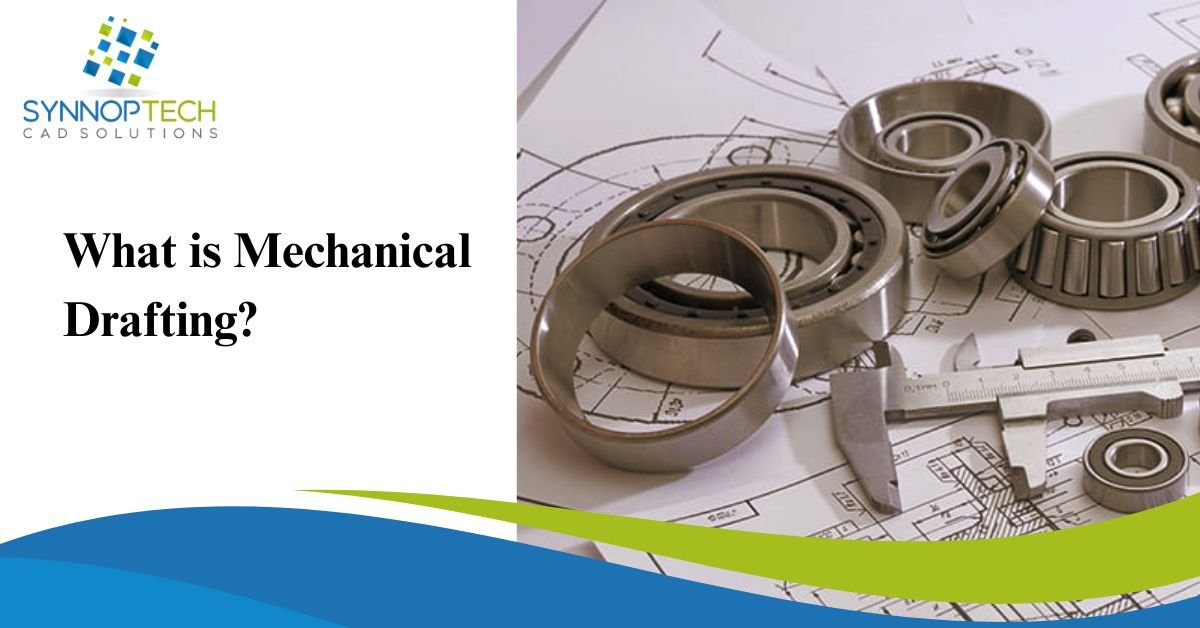
Everything you see that is mechanical—from cars to machines that power industries—starts as an idea on paper. But how does that concept become a rendered idea with precision enough to manufacture? This is where mechanical drafting comes in: the art and science of producing technical drawings for the design and manufacturing of mechanical systems and parts.
Mechanical drafting is the depiction of technical drawings that convey dimension, shape, and assembly of mechanical parts and systems. Drafting can be seen as a tool for engineering, machinists, and manufacturers to create machines and parts in an accurate way that fits with the larger mechanical system.
While structural drafting depicts buildings and load-bearing components, mechanical drafting depicts machines, engines, tools, and equipment. Drafting serves as a bridge between engineering ideas and actual manufacturing.
Why Mechanical Drafting is Important
Mechanical drafting is much more than just creating tidy drawings—it is central to how we do business in modern society. Here’s what it accomplishes:
- Accuracy in Manufacturing – mechanical parts often require tighter tolerances than fractions of a millimeter. Drafting provides those tolerances.
- Clear Communication—all engineers, fabricators, and quality inspectors work off the same drawing set.
- Cost Effectiveness—mistakes in mechanical design often result in wasted materials, too much time being spent on a prototype, and/or a faulty final product. Drafting helps to minimize this problem.
- Facilitating Innovation—robotic systems or renewable energy systems are very complex ideas. Mechanical drafting allows for ideas to be scaled into usable designs.
Without mechanical drafting, industries like automotive, aerospace, or even manufacturing would have constant delays and inefficiencies.
Tools and Technologies in Mechanical Drafting
Mechanical drafting has transitioned from pencil and paper drawings on a drafting board to a highly sophisticated digital environment. The field of drafting is now using:
- CAD software (Computer-Aided Design), such as AutoCAD, SolidWorks, and CATIA, are mainstay tools in the industry for 2D mechanical drawings and 3D mechanical drawings.
- 3D modeling or using 3D full models instead of flat drawings can be tested virtually with stress, movement, and assembly.
- Simulation and Analysis Tools – Software can run real-world scenarios to check performance before a prototype is even built.
- Integration with CNC Machines – Drafted designs can be directly linked to manufacturing machines, improving accuracy and reducing lead time.
This digital shift has revolutionized mechanical drafting, making it faster, more flexible, and more accurate than ever before.
Skills Required for Mechanical Drafting
Technical proficiency and creativity for problem-solving are two important components of drafting in the mechanical profession. A respected mechanical drafter:
- Understands engineering concepts, mechanics, and material characteristics.
- Is proficient in CAD and 3D modeling software.
- Is detail-oriented, as one mistake can cause an entire assembly line to halt.
- Clearly conveys drawings so that machinists and engineers can build the designs.
- Stays up-to-date with the standards of the industry and innovative technologies.
The combination of these skills is what enables the realization of a product, which means it is not only functional but is also safe and efficient to produce.
The Future of Mechanical Drafting
Like many fields, in mechanical drafting new technologies are reshaping the profession; to name a few:
- AI in Drafting – Automation of repetitive tasks and suggesting changes in the design.
- Additive Manufacturing (3D Printing)—Drafters can advance straight to the models they design to be printed for fast prototyping.
- Sustainability/Green Design – Mechanical drafting has taken on an increased involvement in the use of sustainable materials or energy-efficient systems.
- Globalization—Cloud-based capabilities allow drafting teams around the world to work on the same issue at the same time.
New technologies are changing mechanical drafting to the extent that it will no longer be a documentation effort but rather about innovation and smarter design.
Mechanical drafting is the silent force behind nearly every machine and item we use every day. It takes engineering concepts and changes them into an accurate, usable design, helping ensure the product is safe, works, and can be made.
From an airplane engine to the gears on a bicycle, mechanical drafting is an essential part of modern living. Technology will remain at the forefront of innovation in today’s and tomorrow’s world by developing elements of various industries with precision and creativity.
