
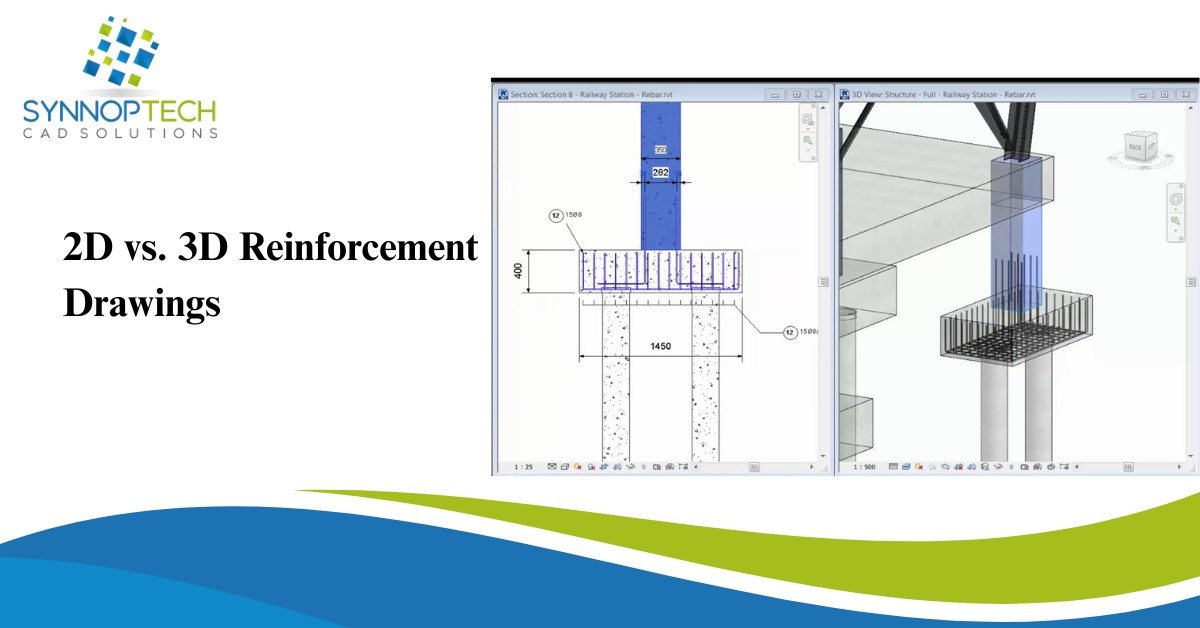
In structural engineering and construction, reinforcement drawings are extremely important since they define the positional details of steel rebars within concrete elements. Traditionally, reinforcement drawings have been made using either hand-drafting or CAD tools in a 2D format. However, as the construction industry adapts and progresses, the smarter and more efficient alternative, 3D reinforcement modeling, is becoming more and more preferred.
In the industry, engineering firms are transitioning from 2D drawings to 3D models more and more. What is starting to differentiate 2D from 3D reinforcement drawings? Let’s break it down.
What Are 2D Reinforcement Drawings?
2D reinforcement drawings are drawings that are made in a flat format that depict the steel structure framework of the concrete element internally. As with other CAD drawings, the 2D reinforcement drawings also consist of:
- 2D Plan and Elevation View Drawings
- Heavy Text Annotations
- Symbols, dimensions, and notes indicating where the rebar is to be placed.
The 2D reinforcement drawings, as in all other features, have been standard in construction for the longest time and have their set of limitations.
- Due to a lack of proper visualization aids, the conceptual intersection of multiple elements is very difficult to interpret.
- Errors due to a lack of proper details being provided or poor drawings are all too common.
- CNC machines are becoming a common way to produce models; however, in 2D work clash detection is very difficult.
- In any work on complex projects that employ 3D visualization, constant on-site confirmations are required.
What Are 3D Reinforcement Models?
With tools such as Revit, Tekla Structures, and Allplan, 3D reinforcement modeling spatially depicts rebar in various structural components. S3D models help users to:
- Visualize rebars fully in beams, slabs, columns, and walls.
- Autonomously detect clashes with other systems (HVAC, electrical, etc.).
- Accurately calculate bar bending schedules (BBS).
- Perform collaborative activities with other participants on BIM workflows.
For a comprehensive understanding of 3D modeling in construction, read our article:
👉 3D Reinforcement Modeling: Construction Work with Smart Technology
2D vs. 3D Reinforcement: Key Differences
Feature 2D Drawings 3D Modeling
Visualization Flat, often fragmented views Full spatial understanding
Detailing manual annotations Embedded, visual detailing
Clash Detection Manual and prone to error Automated and visual
Collaboration Difficult for non-engineers Easy to interpret across teams
Modification Handling Time-consuming and error-prone parametric, automatic updates
Fabrication support requires interpretation. Fabrication-ready outputs
This is why 3D is now integral to the construction industry.
As the complexity of modern construction projects increases, interdiscipline coordination is critical. With 3D models, the construction industry is able to achieve the following:
- Proactive and responsive error detection and resolution.
- Accurate fabrication and placement on-site.
- Reduction in material waste and labor costs.
Streamlined communication with stakeholders, including clients and architects.
When 2D Still Holds Significance
2D has not vanished fully even with 3D gaining popularity as a new standard. 2D still holds significance in the following contexts:
- Small-scale or simpler projects
- Cases with limited budgets, software capabilities, or resources
- Creating site-specific 3D model shop drawings
Real-World Impact: From Disorder to Order
Consider a scenario with integrated plumbing, rebar, and electrical conduits. These systems occupying the same spatial area give rise to numerous conflicts. These conflicts are difficult to solve in 2D and can result in expensive rework. In 3D model representation, these clashes are resolved.
Precision and early detection of issues dramatically reduces costs and saves time in large-scale infrastructure or skyscraper projects.
Conclusion
While 2D reinforced drawings have served as the standard for the construction industry for a long time, they have become inadequate for the contemporary construction demands. 3D reinforcement modeling enhances clarity and fosters accuracy and collaboration—transforming construction planning, execution, and management of intricate structures.
If you are still relying on 2D drawings, it’s time to consider smarter alternatives that can bolster competitiveness and productivity.
To learn how 3D reinforcement modeling is revolutionizing construction practices, check out our in-depth article:
👉 3D Reinforcement Modeling : Construction Work with Smart Technology
