
The architecture, engineering, and construction (AEC) industry is evolving fast, and digital design tools are at the center of this transformation. Two of the most widely used approaches today are BIM and CAD. Both play a powerful role in shaping modern projects, and understanding how they work can help you make smarter decisions.
If you’re exploring BIM vs CAD or trying to understand the difference between BIM and CAD, this guide will walk you through everything in a clear, simple, and positive way.
At Synnoptech CAD Solutions, we help businesses use both approaches effectively—so you can achieve accuracy, efficiency, and better project outcomes.
What is CAD? A Complete Guide to Computer-Aided Design
CAD (Computer-Aided Design) is a technology used to create precise drawings and models digitally. It has been a foundation of design and drafting for decades and continues to be highly valuable across industries.
With CAD, designers can create:
- 2D drawings like floor plans and layouts
- 3D models for visualization
- Technical drawings for construction and manufacturing
CAD is widely used in CAD services, especially when detailed and accurate drawings are required.
Types of CAD Services: From Drafting to 3D CAD Design
CAD supports a wide range of professional needs. Some common applications include:
- CAD design services for concept development and planning
- CAD drafting services for detailed construction drawings
- 3D CAD services for product and architectural visualization
Specialized drawings such as:
- Joinery CAD drawings
- Millwork CAD drawings
These are especially important in interior design, furniture production, and custom fabrication projects.
Many businesses choose to outsource CAD drafting services to save time and ensure professional-quality output.
What is BIM? Understanding Building Information Modeling
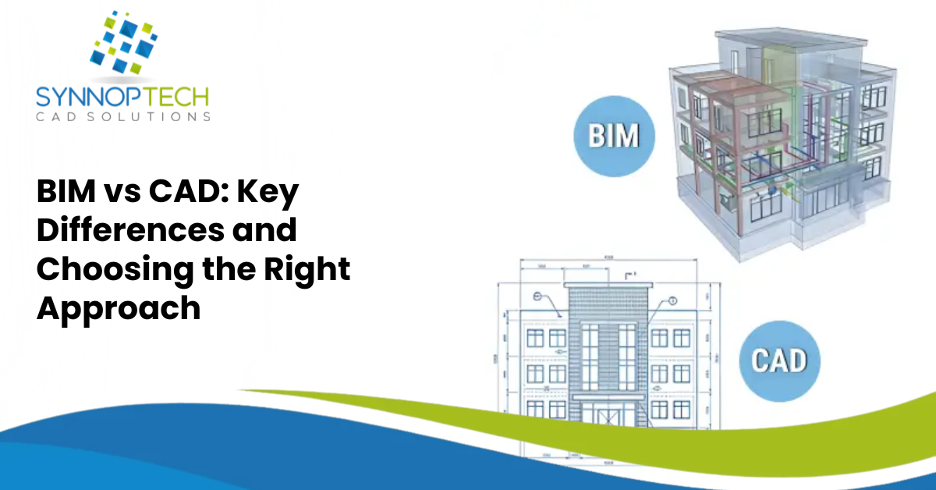
BIM (Building Information Modeling) is a modern approach that goes beyond drawing. It creates a digital representation of a building that includes both design and detailed information.
With BIM, you’re not just creating shapes—you’re building a smart model that contains:
- Geometry
- Materials
- Specifications
- Project data
- Timeline and cost insights
This makes BIM services a powerful solution for managing projects from start to finish.
Types of BIM Services: Modeling, Coordination & 3D BIM Solutions
BIM offers a wide range of capabilities that support modern construction workflows:
- BIM modeling services for creating detailed building models
- 3D BIM modeling services for realistic visualization
- BIM coordination services for seamless integration of multiple systems
- Project planning and lifecycle management
Using architectural BIM software and BIM software for architects, professionals can design, update, and collaborate in real time.
BIM vs CAD: Key Differences Explained Simply
Both BIM and CAD are valuable tools, but they serve different purposes. Let’s explore their strengths in a clear and simple way.
1. Design Approach
- CAD focuses on creating precise drawings and geometric designs.
- BIM focuses on building intelligent models with embedded information.
Both approaches contribute to accurate and efficient project execution.
2. Level of Detail
- CAD provides highly detailed drawings for design and fabrication.
- BIM adds an extra layer of information, helping teams understand how every element works within the project.
3. Collaboration
- CAD supports structured design workflows.
- BIM enhances collaboration by allowing multiple stakeholders to work on a shared model.
4. Visualization
- CAD offers clear 2D and 3D representations.
- BIM provides immersive 3D visualization along with data insights.
5. Project Management
- CAD is excellent for design documentation.
- BIM supports the entire lifecycle of a project—from planning to execution and beyond.
When to Choose CAD: Best Use Cases and Applications
CAD remains a highly effective solution for many use cases. You should consider CAD when:
- You need precise technical drawings
- The project involves detailed fabrication work
- You require fast and accurate drafting
- You are working on interior, furniture, or manufacturing designs
CAD is especially valuable for:
- Joinery CAD drawings
- Millwork CAD drawings
- Detailed shop drawings
Many businesses also choose to outsource CAD drafting services to improve efficiency and quality.
When to Choose BIM: Ideal Scenarios and Benefits
BIM is an excellent choice for projects that benefit from a more connected and data-driven approach.
You should consider BIM when:
- The project involves multiple teams
- You want better coordination between systems
- You need a complete digital representation of the building
- You want to improve planning and visualization
With 3D BIM modeling services and BIM coordination services, teams can work more efficiently and make informed decisions at every stage.
BIM + CAD: How They Work Together for Better Results
In real-world projects, BIM and CAD often work side by side—and this combination delivers excellent results.
How They Complement Each Other
- BIM creates the overall intelligent model
- CAD provides detailed drawings and documentation
For example:
- A BIM model defines the building structure and systems
- CAD drawings support fabrication and execution
At Synnoptech CAD Solutions, we integrate both CAD services and BIM services to create a complete and efficient workflow.
Industries Using CAD and BIM for Modern Design and Construction
CAD Applications
CAD is widely used in:
- Manufacturing
- Interior design
- Mechanical engineering
- Furniture and product design
It plays a key role in 3D CAD services and custom component design.
BIM Applications
BIM is widely used in:
- Architecture
- Construction
- Infrastructure development
- Real estate projects
It supports advanced workflows through BIM modeling services and collaborative planning.
Benefits of CAD in Design and Drafting
CAD continues to deliver strong value across industries:
- High precision in design and drafting
- Fast creation of technical drawings
- Flexibility for different project types
- Essential for fabrication and detailing work
Benefits of BIM in Construction and Planning
BIM brings a modern, integrated approach to project execution:
- Enhanced collaboration across teams
- Better visualization and planning
- Improved coordination between systems
- Data-driven decision making
- Support for the entire project lifecycle
CAD or BIM? How to Choose the Right Approach for Your Project
Choosing between BIM vs CAD depends on your project needs. Instead of comparing them as competitors, it’s more helpful to see them as complementary tools.
Consider These Factors
- Project size and complexity
- Number of stakeholders involved
- Level of detail required
- Need for collaboration and coordination
- Long-term project goals
Simple Guidance
- Use CAD for detailed drawings and fabrication work
- Use BIM for collaborative, data-driven project management
- Use both together for maximum efficiency
Why Outsourcing CAD and BIM Services is a Smart Business Move
Outsourcing has become a smart strategy for businesses looking to scale efficiently.
Why Outsource?
- Access to experienced professionals
- Faster project delivery
- Cost-effective solutions
- Scalable resources based on project needs
You can:
- Outsource CAD drafting services for precise drawings
- Use BIM services for advanced modeling and coordination
At Synnoptech CAD Solutions, we provide end-to-end support—from CAD drafting services to 3D BIM modeling services—helping clients achieve better results with less effort.
Future of BIM and CAD: Trends Shaping the AEC Industry
The future of design lies in combining the strengths of both BIM and CAD.
Emerging Trends
- Increased adoption of BIM in large-scale projects
- Integration with AI and automation tools
- Cloud-based collaboration platforms
- Growth of digital twins and smart buildings
Both CAD and BIM will continue to evolve, offering even more powerful capabilities for design and construction.
Final Thoughts: BIM vs CAD – Choosing the Right Approach for Success
Understanding BIM vs CAD helps you choose the right approach for your project. Both technologies are powerful, and each brings unique advantages.
- CAD is excellent for precision and detailed drafting
- BIM is ideal for intelligent modeling and collaboration
When used together, they create a complete and efficient workflow that supports every stage of a project.
If you’re looking to streamline your design workflow with expert CAD and BIM solutions, partnering with the right service provider can make a significant difference.
At Synnoptech CAD Solutions, we specialize in delivering high-quality CAD design services, CAD drafting services, 3D CAD services, and advanced BIM modeling services tailored to your needs.
FAQs: BIM vs CAD – Key Differences and Applications
1. What is the main difference between BIM and CAD?
The main difference between BIM and CAD is that CAD focuses on creating precise drawings and designs, while BIM creates intelligent 3D models that include both design and detailed project data. BIM also supports collaboration and project lifecycle management.
2. Is BIM better than CAD?
BIM and CAD both offer strong advantages depending on the project. BIM is ideal for projects that require collaboration, visualization, and data-driven planning, while CAD is highly effective for precise drafting and detailed technical drawings. Many projects benefit from using both together.
3. Can BIM and CAD be used together in a project?
Luxury kitchen cabinets require an elevated level of detail in your drawings: material grade and origin callouts (e.g., American Black Walnut, grade 1 face), veneer match type (book-match, slip-match), surface profile details for fluting/reeding, high-end hardware from specified manufacturers (Blum, Salice, Hettich), and specialty finish references from approved supplier catalogues.
4. What are BIM modeling services?
Yes. SynnopTech CAD Solutions regularly handles large-scale commercial millwork packages including hotels, restaurants, retail fit-outs, and multi-unit residential developments. We can scale our team to meet tight submission deadlines and have experience with Australian, UK, and North American documentation standards.
5. What are CAD drafting services?
We deliver drawings in AutoCAD (.dwg/.dxf), PDF (print-ready and layered), Cabinet Vision, Microvellum, and SketchUp formats. We can also provide CNC-ready DXF cut files when required by your manufacturing partner.
6. When should I choose BIM over CAD?
You should choose BIM when your project involves multiple teams, requires better coordination, or needs advanced visualization and planning. BIM is especially useful for large-scale and complex construction projects.
7. When should I use CAD services?
CAD services are ideal when you need detailed technical drawings, fabrication designs, or precise layouts. They are widely used in manufacturing, interior design, and engineering projects.
8. What industries use BIM and CAD the most?
CAD is widely used in manufacturing, product design, and interior design, while BIM is commonly used in architecture, construction, infrastructure, and real estate development.
9. What is BIM coordination and why is it important?
BIM coordination is the process of integrating different building systems—such as structural, electrical, and plumbing—into a single model. It helps ensure that all components work together smoothly and improves overall project efficiency.
