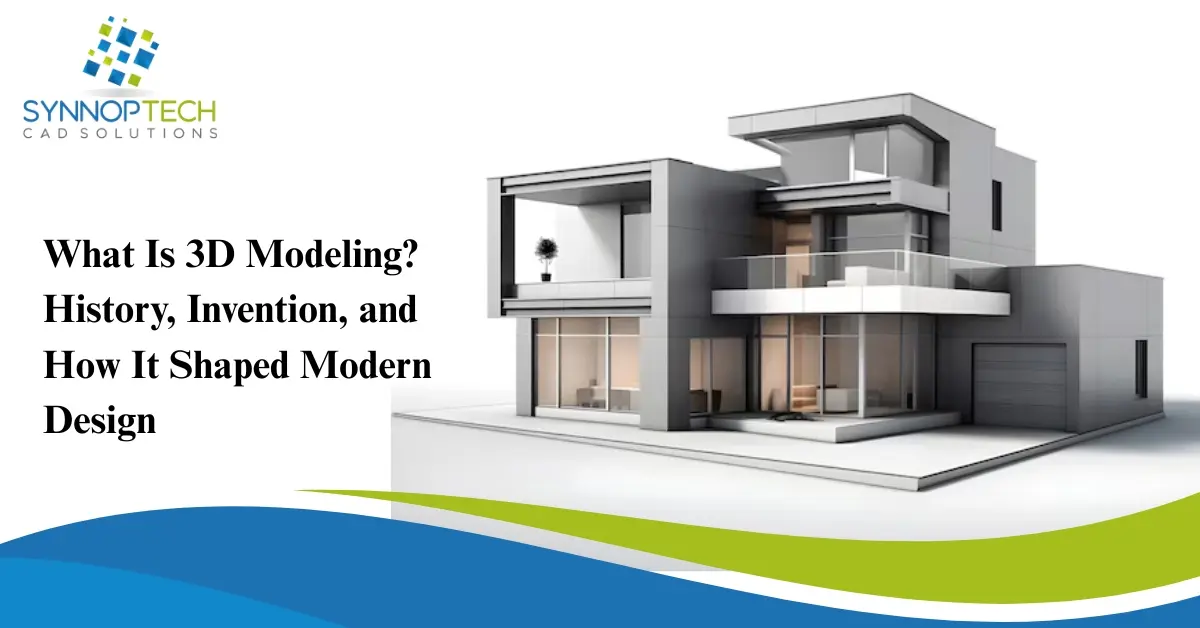
3D modeling is prevalent today; movies, architecture, gaming, engineering, and even healthcare use it. 3D modeling is the art and science of converting your imagination into a physical format of digital technology. But where did it begin? Who invented it? And how did it become the sophisticated tool we use today?
Let us take a look at the origins, evolution, and impact of 3D modeling, which some claim is the greatest innovation in the history of design and visualization.
What is 3D modeling?
3D modeling is the process of creating a three-dimensional representation of a surface or object using a specialized software program. In the case of 2D drawings, you would only see height and width, but in 3D modeling it will add depth, so you can see and rotate objects through any angle.
Objects are built using geometrical shapes such as vertices, edges, and polygons. And they can represent anything from a simple chair to an entire city.
3D models are used in a wide range of industries:
- Architecture: Building designs and walkthroughs.
- Engineering: Product prototypes and mechanical assemblies.
- Entertainment: Characters, animations, and visual effects in movies and games.
- Medicine: Surgical simulations and 3D-printed implants.
The Origins of 3D Modeling
The emergence of 3D modeling can be traced back to the beginnings of computer graphics in the 1960s. Even then, computers were big, slow, and limited in value, but inspired researchers saw their potential for visual representation.
In 1963, computer scientist Ivan Sutherland at MIT developed Sketchpad, the very first computer-aided design (CAD) program. Sketchpad allowed users to draw simple shapes on a screen and move them around interactively—a revolutionary idea that set the stage for 2D drafting as well as 3D modeling.
Sutherland’s work changed thinking in design. It raised the notion that computers could be used for creative visualization, rather than only calculation.
1970s–1980s: The Foundation of 3D Computer Graphics
In the 1970s, computer scientists began to explore the mathematical representation of 3D objects. Edwin Catmull and Jim Blinn, for example, developed the algorithms that allowed curves to be represented and shaded on a computer.
In 1972, Catmull produced the first digital 3D model—a simple wired form of his left hand. Though rudimentary by modern standards, it was revolutionary at that time and now stands as one of the most iconic moments in computer graphics history.
By the 1980s, software like AutoCAD (1982) and CATIA (1977) introduced 3D capabilities for engineering and architecture. Meanwhile, the entertainment industry began using 3D modeling for visual effects — leading to early CGI appearances in films such as Star Wars (1977) and Tron (1982).
The 1990s: The Rise of Modern 3D Software
The 1990s marked a golden era for 3D modeling. Software tools became more advanced, and personal computers became powerful enough to handle complex graphics.
Some of the most influential 3D programs were born during this period:
- 3D Studio (later 3ds Max) by Autodesk (1990)
- Maya by Alias (1998)
- LightWave 3D and Cinema 4D, popular among animators and artists
These tools introduced intuitive interfaces, polygonal modeling, texture mapping, and rendering engines — allowing artists to create realistic, detailed 3D worlds.
At the same time, industries like automotive design, product development, and architecture adopted 3D modeling for visualization, testing, and marketing.
The 2000s: From Screens to Reality
By the 2000s, three-dimensional, or 3D, modeling was central to nearly every visual industry. Film studios were using it to produce realistic computer-generated animation, and architects could create photorealistic renderings for clients to review.
One large breakthrough in this era was 3D printing, which allows digital models to become physical objects. Designers could prototype directly from their 3D files, changing manufacturing, healthcare, and fashion completely.
Video games also went through incredible advancements, attaching titles, such as The Sims, Half-Life 2, and Assassin’s Creed, to the artistic and technical power of real-time 3D modeling.
The Present and Future: AI and Realism
Today’s standards of 3D modeling are an important part of most modern workflows. Software applications such as Blender, ZBrush, SolidWorks, Rhino, and Autodesk Maya can produce precise photorealistic 3D models.
The rise of artificial intelligence and machine learning is changing the landscape of the history of 3D modeling. AI tools can even automate the process of 3D modeling by generating objects from a 2D picture or drawing, reducing production time drastically.
Virtual reality and augmented reality applied to 3D modeling create a level of immersion never seen before. Architects can walk through their digital buildings, and modeled objects can be tested virtually before the actual product is manufactured.
How 3D Modeling Differs from 2D Drawing
| Aspect | 2D Drawing | 3D Modeling |
| Dimensions | Length & Width | Length, Width & Depth |
| Output | Flat representation | Volumetric, rotatable object |
| Tools | AutoCAD 2D, Illustrator | Blender, Maya, SolidWorks |
| Use | Blueprints, layouts | Prototypes, simulations, visualizations |
| Experience | Analytical and precise | Visual and spatial |
While 2D drawings serve as the foundation of design, 3D modeling transforms ideas into visual and interactive realities.
Why 3D Modeling Matters
3D modeling is more than just a design tool — it’s a way of thinking. It allows us to explore form, function, and feasibility before anything is built.
- For architects, it means presenting lifelike walkthroughs to clients.
- For engineers, it enables stress testing and product refinement.
- For artists, it offers a new canvas of limitless creativity.
In essence, 3D modeling bridges the gap between imagination and implementation.
Conclusion
Starting with Ivan Sutherland’s basic wireframe shapes in the 1960s, 3D modeling has stretched the limits of creativity and innovation globally to the hyper-realistic forms of a digital world we experience today. 3D modeling is the backbone of modern design, the scaffolding behind everything we see on screens and in our everyday lives.
As technology continues to advance, as we’ve seen in the innovation of 3D modeling, AI, VR, and simulation are all part of the evolution of 3D modeling, where design can happen faster, smarter, and become more immersive. The journey from a flat line to a full digital object tells a story—a story of how humans have never stopped imagining in the third dimension.